 English

 New goods

Description
The search kit KP-500K (version 3) is a search kit consisting of the GP-500K search engine integrated into the case, and the search receiver PP-500A, packed in a similar case.
The warranty period is 24 months.
PURPOSE:
Highly accurate location of damage to underground cables by induction, acoustic and potential methods.
Survey of the terrain and the search for communications routes, including those under voltage (cable lines, pipelines, etc.).
Determination of the depth of underground communications.
The choice of cable from the beam.
Localization of cable sheath damage, including with XLPE insulation.
Burning of defective cable insulation.
The search kit KP-500K provides operation with cable lines with a length of up to 50 km and a depth of up to 12 m.
The accuracy of the localization of the damage site depends on the nature of the damage (phase closure on the shell, interfacial closure, breakage of the conductors with or without grounding), skills and practical skills of the user. The maximum accuracy of the fault location is 10 cm.
Methods of work:
Induction method. The current generated by the GP-500K generator induces an electromagnetic field around the communication. Using the magnetic antenna MA-500 search receiver PP-500A, located in this field, an electrical signal is detected. The signal level serves as an informative search parameter. The spatial location of local maxima and minima of the signal with respect to communication allows us to determine its route and depth of occurrence. The application of this method makes it possible to determine the location of couplings, shielding floors and places of damage to the cable line.
Acoustic method. An informative signal is the level of a momentary sound signal (click, shock) that occurs simultaneously with an electric spark or arc discharge that occurs at the point where the cable is damaged when a high voltage electric voltage pulse is applied to it. A high-sensitivity acoustic sensor AD-500 is used to monitor and display the signal, converting the sound signal into an electrical signal. The sensor is connected to a portable universal receiver PP-500A, equipped with sound and visual indication.
Potential method. The potential difference is created by the distributed currents flowing in the volume of the ground, which are induced by the electromagnetic field around the communication, or arise as a result of leakage in the place of insulation damage, where galvanic connection with the ground is formed. A constant and alternating current of increased frequency (sound range) is used. The magnitude of the measured voltage and the nature of its variation along the communication are informative parameters for locating the fault location using a potential AP-500 device (A-frame).
Characteristics
- Limiting the maximum current (Im) relative to the agreed value
- 117%
- Power consumption, no more
- 800 watts
- Generator operating position
- any position with secure attachment
- Time of readiness for work at ambient temperature below -10 ° С
- 1 min
- Continuous work time
- not limited
- Generator output power
- 500 watts
- Generator output power for matched active load, not less
- 500 watts
- Generator output voltage for a matched load of 8 Ohm
- 64 ± 4V
- Generator output current for a matched load of 8 Ohm
- 8 ± 0.5 A
- Overall dimensions of the generator
- 525 x 185 x 475 mm
- Depth of the cable
- up to 12 m.
- Matching ranges
- 0.5, 1, 2, 4, 8, 16, 32, 64, 128, 256 Ohm
- Cable line length
- up to 50 km.
- Burning of defective cable insulation
- there is
- Temperature control
- there is
- Short-circuit current of the generator in the matching range of 0.5 Ohm
- 37.6 ± 1.9 A
- Generator control
- autonomously with indication of modes and parameters on the display, remotely from a personal computer via the RS-232 or RS-485 interface
- Generator output waveform
- sinusoid
- Non-volatile saving of the set operating mode and subsequent call of this mode by the operator
- there is
- Matching the generator output impedance to the load
- automatic or manual
- Ambient temperature
- from -30 to +40 ° С, the generator can be operated at ambient temperatures up to + 55 ° С, while the output power is automatically reduced by the security system.
- Generator self-diagnostics
- there is
- Quality control of commutation of a generator with a power source, tested communication, grounding, personal computer
- there is
- Generator supply voltage from the alternating current network with a frequency of 50 Hz
- from 187 to 242 V.
- Generator supply voltage monitoring
- there is
- Nonlinear distortion coefficient at operating frequencies, no more
- 1%
- Maximum output current
- 39.5 A
- Generator weight
- 20 Kg
- Microprocessor control
- there is
- Multi-frequency mode (two-, three-, multi-frequency alternating modes)
- there is
- Open circuit voltage of the generator at the matching range of 256 Ohm
- 450 ± 20V
- Generator operating frequencies
- 480, 1069, 9796 Hz
- Total matching range
- 0.35 to 362 ohms
- Working hours
- continuous or pulsed
- Limitation of the maximum voltage (Um) in relation to the agreed value
- 125%
- Relative humidity at 25 ° С
- 90%
- Automatic limitation of output power, current and voltage when operating on reactive load, short circuit or no load without degrading the parameters of the generator.
- there is
- Automatic load balancing
- there is
- Atmosphere pressure
- from 630 to 800 mm Hg Art.
- Ability to customize generator frequencies (add, change)
- there is
- Possibility of supply from IPT
- foreseen
- Time of readiness for work at ambient temperature above -10 ° С
- 5 sec
Similar products


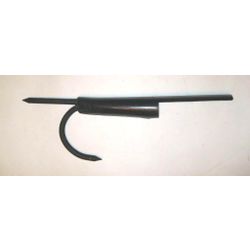
Hanging fire hook for installation of wooden poles BPN-16-600-59 supporting
- Vendor code
- 2270
Price 32.59 USD

Supporting stagger for installation of wooden supports RPN-20-630-59 supporting
- Vendor code
- 2271
Price 31.75 USD